Outgrown a flight-department scheduler? Move the whole operation to one connected record.
Airplane Manager is an established corporate flight-department scheduling platform, with a large integration and partner network built up over 18 years.
FlightStratix takes a different shape. It connects quoting, trip support, crew, compliance, documents and invoicing on the same trip record, so the commercial and operational sides live in one product rather than across a scheduler and its partners.
If you ran charter on Airplane Manager, or you have outgrown scheduling, this is the move.
How this comparison was reviewed
FlightStratix publishes this comparison. We assess workflow fit, feature coverage, implementation approach and publicly available product information for each platform. Competitor features, integrations and pricing can change, so verify requirements directly with the vendor before purchasing.
Airplane Manager and all other product names, logos and trademarks are the property of their respective owners and are used here for identification and comparison purposes only. FlightStratix is an independent product and is not affiliated with, sponsored by, or endorsed by Airplane Manager. This comparison reflects FlightStratix's own assessment based on publicly available information as of the review date above and may not reflect the vendor's latest releases; confirm current capabilities and pricing directly with Airplane Manager.
Airplane Manager is a capable scheduler.
FlightStratix is a different shape of product.
Both cover serious aviation requirements. The difference is how much of the operation lives in one place. Airplane Manager centres on scheduling and connects out to specialist partners; FlightStratix keeps quoting, services, compliance and finance in the same trip record.
We will not tell you Airplane Manager is closing or that it is only a calendar. It is an active product with estimates, flight-log invoicing, maintenance visibility and a large integration network. The useful question is how much of your operation you want in one connected record.
One connected record, with the deeper work in the same product.
A scheduler plans the flight. A connected operations platform also runs the quote, the services, the compliance and the money, all reading from the same trip. That is the difference we are building around.
Create the request once. Everything else reads from the same trip, so a user can follow the work without asking which tool owns the information.
Each role sees what matters to them, while the commercial and operational records stay connected underneath.
The core workflow is intended to be understood within the first working day.
Per aircraft, or flat per company.
Tiered by product and aircraft count
One flat company plan, everything included
Priced per aircraft. Figures below are the published monthly totals covering all aircraft on the plan.
Airplane Manager pricing is its published pricing effective January 2026, checked 6 September 2026; confirm current pricing directly with Airplane Manager. Depending on your fleet, either model can produce a different total, so compare both for your actual operation.
See the workspace behind the comparison.
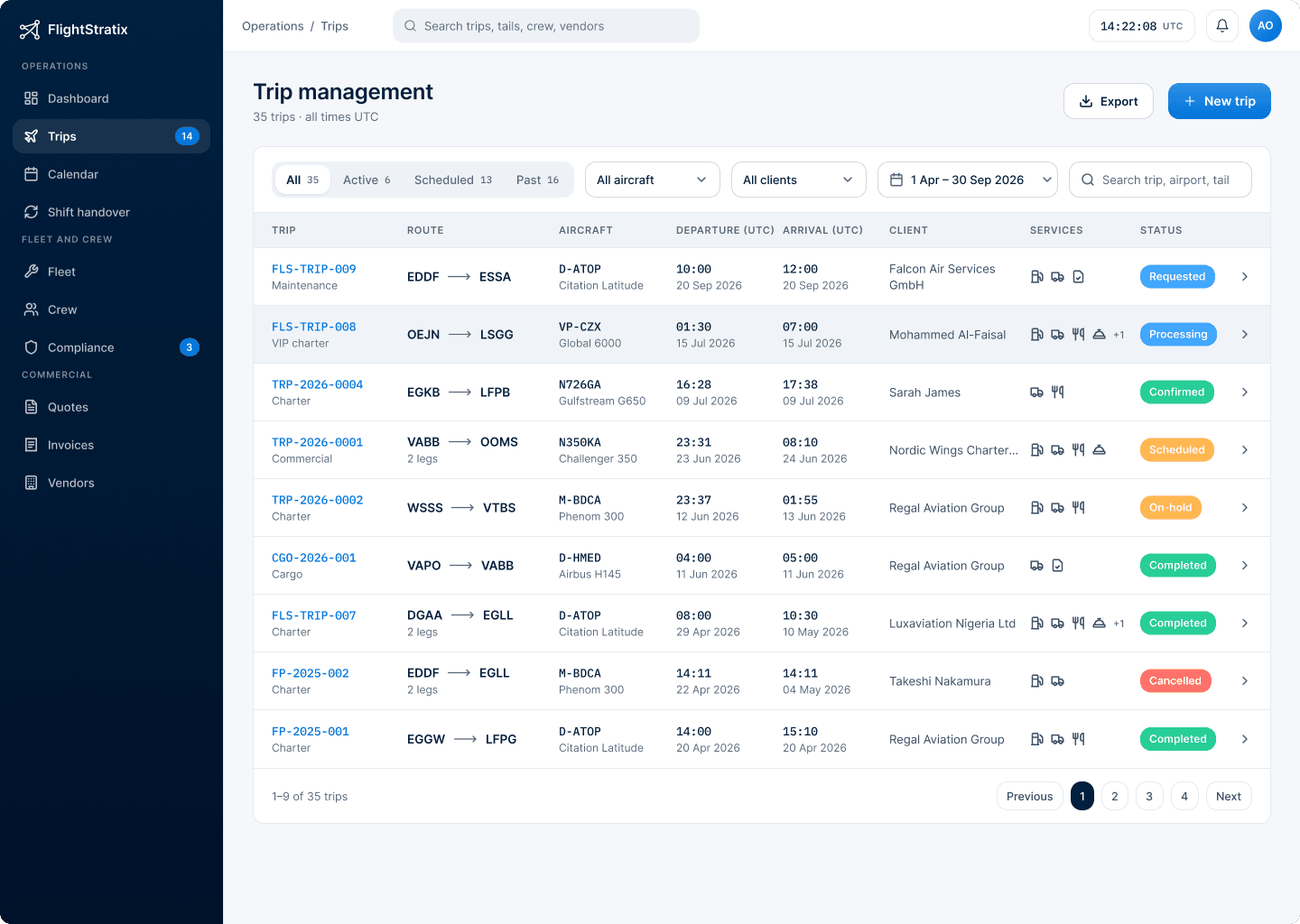
Where the two products differ.
Both are capable. This maps the differences worth evaluating, based on publicly available Airplane Manager material.
| Area | FlightStratix | Airplane Manager (public info) |
|---|---|---|
| Primary design | A connected operations platform: quote, trip, per-leg services, compliance and finance on one record | Corporate flight-department scheduling at the core, connected out to a large integration and partner network |
| Charter sales & quoting | Native multi-aircraft quoting, client acceptance and quote-to-trip | Estimates (previously quoting) and trip requests; industry reports indicate the dedicated charter product was retired in 2025* |
| Client invoicing & margin | Auto-invoicing with cost-vs-sell margin on every service line | Flight Log Invoicing and expenses to a billable department |
| FTL & duty compliance | Configurable EASA / FAA FTL workflow with checks before a trip is published | Duty and rest logging with conflict visibility; no public evidence of a configurable FTL rules engine or dispatch blocking* |
| Trip-support services | Per-leg fuel, handling, permits and catering as records with vendor, cost, sell and documents | International handling, GenDec and eAPIS tools natively; wider trip support and fuel handled through partners (EVO, Jetex) |
| Dispatch & maintenance | Native operational readiness plus maintenance and MEL visibility | Squawks and due items natively; deeper maintenance and 24/7 dispatch via partners (Traxxall, Veryon, IFCC) |
| Pricing model | Flat company pricing; aircraft count is not a separate subscription line | Published tiers priced by product and number of aircraft* |
| Track record & mobile | A newer platform | 18+ years, a large install base, a mature mobile app and a broad integration catalogue |
*Based on publicly available Airplane Manager material reviewed 6 September 2026, including 2025 industry reports of its charter-product retirement. Capabilities and pricing change; confirm current capabilities directly with Airplane Manager.
Not because Airplane Manager is failing. Because they want more of the operation in one place.
Charter quote to invoice, with margin, on one record.
Build a multi-aircraft quote, win the work, and the accepted quote becomes the trip. Cost and sell values follow the services through to the invoice.
For a charter operation this is the difference between a scheduler that plans the flight and a platform that also runs the commercial side. If you were on Airplane Manager's charter product, this is the workflow you are looking to replace, in one place rather than across estimates, logs and expenses.
Quote, trip and invoice on the same record.Trip-support services owned in the platform.
Fuel, ground handling, catering, permits and transport attach to the leg with their own vendor, status, cost, sell value and documents.
Airplane Manager handles international handling, GenDec and eAPIS natively and connects to partners such as EVO and Jetex for wider trip support and fuel. FlightStratix keeps those service records inside the same trip your ops team is already working in.
Services as records, not a separate partner invoice.An FTL compliance workflow, not just a duty log.
Duty and rest checks run against your framework before a trip is published, so crew legality is part of readiness rather than a separate spreadsheet.
Airplane Manager provides duty and rest logging and a duty-time Gantt with conflict visibility, which is useful. We found no public evidence of a configurable EASA or FAA FTL rules engine that blocks dispatch on legality. If a regulatory FTL engine matters to your operation, this is a clear difference to test.
Legality checked as part of the workflow.One connected record instead of a scheduler plus a network.
Airplane Manager is built around scheduling and connects outward to specialist vendors for trip support, dispatch, maintenance, flight planning and SMS.
That partner model works well for many flight departments. FlightStratix owns more of the workflow natively, so operations, crew, services and finance read from the same trip without stitching several tools together. Which approach fits depends on how much you want in one product.
Deeper work in the same product, not bolted on.Flat company pricing instead of per-aircraft tiers.
Airplane Manager's published pricing scales with the number of aircraft on the plan and adds a fee for each aircraft beyond five.
FlightStratix is one flat company plan: aircraft count is not a separate subscription line and aircraft MTOW does not change the price. Depending on your fleet the totals differ, so compare both for your actual operation rather than a headline number.
Add a tail without a new line item.Operations shift handover as a record.
Close a shift and generate a structured handover of activity, open items and upcoming trips for the incoming desk.
This keeps continuity across the operations desk in one place, instead of a verbal briefing or a separate document. It is one of the workflows that sits naturally inside a connected trip record.
The next shift reads what changed.Airplane Manager has real strengths.
A credible comparison should say them clearly.
If any of these is a hard requirement, check it before changing systems. If FlightStratix cannot support an essential requirement, we would rather tell you before you migrate.
Moving from Airplane Manager? Evaluate first, move second.
Especially if the charter-product change affected you, test the replacement on your own operation before you commit.
Questions from teams comparing Airplane Manager and FlightStratix.
Explore FlightStratix solutions
Airplane Manager schedules the flight.
FlightStratix connects the whole operation.
We are not going to tell you Airplane Manager is closing or that it cannot do the job, that would be false. Our argument is different: if your operation now runs on charter, services, compliance and finance, you may want them in one connected record rather than across a scheduler and its partners.
30 minutes. Your operation. No generic feature presentation. Standard migration targeted within 24 to 48 hours.*