Two aviation platforms with deep capability. Two different ideas about how much product your team needs.
myairops has decades of aviation software history and a broad product family covering flight operations, ground operations, FBOs, continuing airworthiness and other aviation workflows.
FlightStratix is newer and more focused. Our product idea is straightforward: keep the underlying operation deep, and keep everyday use simple.
Trips, aircraft, crew, services, compliance, documents and money can all be connected without asking every user to understand every part of the platform.
How this comparison was reviewed
FlightStratix publishes this comparison. We assess workflow fit, feature coverage, implementation approach and publicly available product information for each platform. Competitor features, integrations and pricing can change, so verify requirements directly with the vendor before purchasing.
myairops and all other product names, logos and trademarks are the property of their respective owners and are used here for identification and comparison purposes only. FlightStratix is an independent product and is not affiliated with, sponsored by, or endorsed by myairops. This comparison reflects FlightStratix's own assessment based on publicly available information as of the review date above and may not reflect the vendor's latest releases; confirm current capabilities and pricing directly with myairops.
myairops is not simply software for large operators.
The real question is which product approach fits your team.
myairops publicly says its technology supports a corporate flight department with one aircraft through a charter operator managing 300 aircraft, across flight, ground, crew, maintenance, FBO, CAM, fuel, finance, reporting and integrations. Both platforms cover serious aviation requirements. The difference is the approach.
FlightStratix does not need to invent a weakness to make a useful comparison. myairops covers small fleets, trip support, FBO, crew, FTL, maintenance, fuel and finance. The interesting question is how much of the system each person has to understand to do their job.
Depth that stays out of the way.
Aviation operations contain a lot of information. But the dispatcher does not need all of it. Neither does the pilot. Neither does the accountant. FlightStratix gives each role access to the work relevant to them while the records stay connected underneath.
Start with one trip. Everything else reads from it, so a user can follow the work without asking which module owns the information.
That means we can keep adding operational depth without expecting every user to become an expert in the entire system.
The difficult parts of aviation should live in the system, not in the user's head.
Don't let either vendor hide behind an abstract starting from.
Request a current proposal
One flat company plan, everything included
No standard public subscription price was found in the material reviewed. Request a proposal, then compare it like for like.
Compare subscription, users, aircraft, required products and modules, integrations, migration, training, support and contract period. The cheaper logo is irrelevant; the question is the total commercial model for your operation.
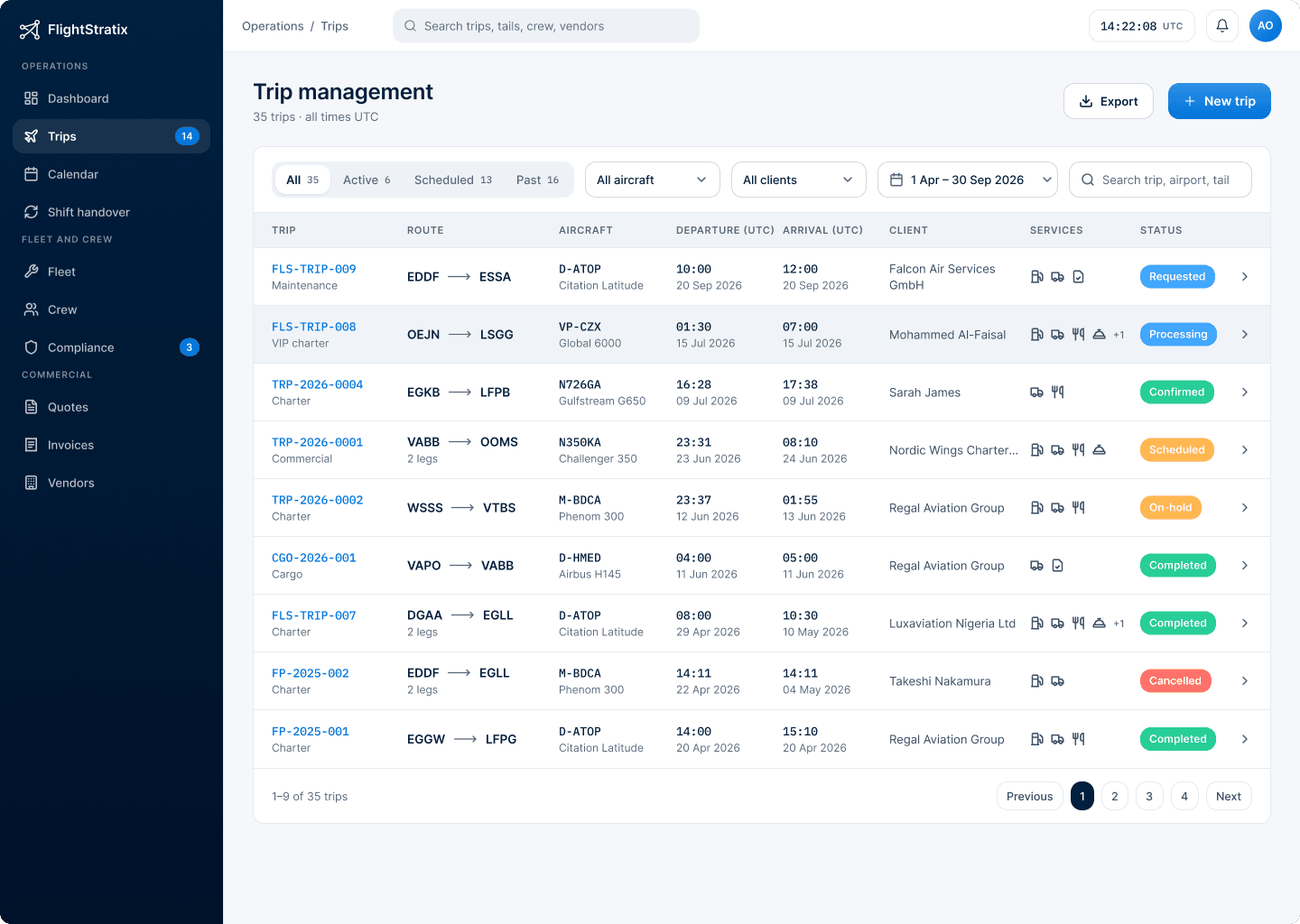
See the workspace behind the comparison.
Where each platform is strong.
Both product families are capable. This maps where each tends to lead, based on public myairops material reviewed on the date above.
| Capability | FlightStratix | myairops |
|---|---|---|
| Core operations | ||
| Multi-leg trip management | Yes | Strong |
| Fleet & aircraft management | Yes | Strong |
| Crew profiles & rostering | Yes | Strong |
| Multi-aircraft quoting | Strong | Yes |
| Public embeddable RFQ form | Strong | Partial |
| Trip & ground services | ||
| Fuel management + vendor pricing | Strong | Strong |
| Ground handling coordination | Strong | Strong |
| Catering per pax with dietary | Strong | Yes |
| Concierge, hotels, transfers | Strong | Yes |
| Permits & clearances tracking | Strong | Yes |
| Services split by departure AND arrival | Strong | Partial |
| Compliance & airworthiness | ||
| EASA FTL engine | Yes | Strong |
| MEL tracking with dispatch-blocking | Yes | Strong |
| Continuing airworthiness (CAM) depth | Partial | Strong |
| Component lifecycle tracking | Yes | Strong |
| Flight Risk Assessment Tool (FRAT) | Yes | Yes |
| Flight change acknowledgement per person | Strong | Partial |
| Flight watch, movement & tech log | ||
| Flight watch: scheduled / estimated / actual OOOI | Yes | Strong |
| Delay, diversion & CTOT tracking | Yes | Strong |
| Live tracking map + movement messaging | Partial | Strong |
| Journey & technical log | Yes | Strong |
| Shift handover | ||
| Operations shift closure PDF | Strong | Partial |
| Auto-pulled activity + upcoming outlook | Strong | Partial |
| Finance, quoting & FBO | ||
| Cost vs sell margin per line | Strong | Strong |
| Auto-invoicing from trip data | Yes | Strong |
| Dedicated FBO workspace / billing | Yes | Strong |
| Payment link to client | Strong | Yes |
| Product family & integrations | ||
| Products to buy for full coverage | 1 | multiple |
| Custom integrations on request | Strong | Yes |
| Established third-party catalogue | Partial | Strong |
| Enterprise, defense & HEMS deployments | Not a focus | Strong |
| Simplicity, support & fit | ||
| Core daily workflow understandable quickly | Strong | Yes |
| 24/7 live chat support | Strong | Partial |
| Direct access to the product team | Strong | Partial |
| Pricing & onboarding | ||
| Flat per-company pricing | Strong | confirm |
| Every feature included, no add-ons | Strong | confirm |
| Per-aircraft pricing | Not a focus | confirm |
| Standard migration target | 24-48h ★ | confirm |
| Free trial | Yes | demo-first |
Competitor information reflects publicly available myairops material on the review date. Confirm current capabilities directly with myairops. *Standard migration timing assumes reasonably structured source data; larger or incomplete datasets may take longer.
Not because myairops is missing aviation features. Because FlightStratix approaches the work differently.
One connected trip record.
A trip can connect request, quote, aircraft, crew, passengers, handling, fuel, catering, transport, permits, documents, readiness checks, changes, actuals and the invoice.
The important part is not merely that these functions exist. It is that a user can follow the trip without constantly asking which module owns this information. The trip stays the operational reference point.
Enter information once. Keep using it.Core workflow first, advanced configuration second.
Our onboarding goal is for a normal operations user to understand the main workflow within one working day.
A dispatcher can learn dispatch. Crew can learn crew. Finance can learn finance. The deeper configuration stays available to the people responsible for it. This is not a promise that every administrator masters every setting in a day. They do not need to.
Advanced configuration can come later.Service-heavy operations stay structured.
For a trip support desk or charter operation, each leg may need fuel, handling, catering, transport, hotels, permits, clearances, slots, documents, supplier communication, supplier costs and client charges.
FlightStratix gives operational service records their own status, vendor, financial and document information while keeping them attached to the trip. myairops also has significant ground operations, FBO and fuel capability, so the useful question is how quickly a coordinator can see every open service and how a time change flows through.
The service is a trackable record, not a note on a flight.Operations shift handover becomes a record.
myairops discusses the importance of a shared operations board at shift changes. FlightStratix adds a dedicated operations shift closure workflow.
Select the handover period and FlightStratix can gather activity during the shift, services touched, status changes, pending work, upcoming trips, items needing attention and carried-forward issues, then generate a structured PDF for the incoming shift.
A clear statement of what changed, what is open and what happens next.Cost and sell stay tied to the work.
FlightStratix lets internal supplier cost and client sell values sit against operational records. Fuel, handling, catering, permits and other charges can each carry cost and sell.
Those values contribute to the broader commercial picture. myairops also has substantial quotation and financial capability, so the distinction is not margin versus no margin. It is how easily operations and finance can follow commercial information from the work to the final invoice.
Commercial information follows the operational work.We deliberately limit bespoke complexity.
FlightStratix customers speak directly with the product team. That does not mean we build custom software for every account.
When a customer requests something we ask: is the operational problem real, will it happen repeatedly, would solving it help other operators, and can it fit naturally into the existing workflow? If yes, we consider adding it to the core platform. We want customers shaping the product, not every customer running a different product.
Add depth where it helps. Avoid complexity for its own sake.myairops has real strengths.
A credible comparison should say them clearly.
If any of these is a central requirement, myairops deserves a direct look. If FlightStratix cannot support an essential requirement, we would rather tell you before you migrate.
Both websites talk about simplicity. So test it, don't believe it.
Give both vendors the same operation and the same people. Bring one real trip, London to Dubai, two possible aircraft, a crew document near expiry, an open MEL item, a 90-minute delay after confirmation, supplier invoices and a shift change. Then score the experience:
- How long until the dispatcher can work without guidance?
- How much information is visible at once?
- How many places must they go to complete a trip?
- How much configuration must they understand?
- Can they ignore areas outside their role?
- Can the night shift understand what the day shift changed?
- Can finance understand the final trip without rebuilding it?
- How much of the product does each role need to learn?
That result is more useful than a hundred-row feature checklist. The winner should become obvious from your own workflow.
Already using myairops? Evaluate FlightStratix without removing it.
Run the comparison on your own operation first.
The questions teams comparing myairops and FlightStratix ask.
Explore FlightStratix solutions
myairops has breadth, history and a large product family.
FlightStratix is focused on making deep work feel simple.
We are not going to tell you myairops cannot manage small fleets, or that it lacks FTL, fuel, FBO software, reporting or migration. Those statements would be false. Our argument is different: your team can get the operational depth it needs without carrying all of it through every screen and every role.
30 minutes. Your operation. No generic feature presentation. Standard migration targeted within 24 to 48 hours.*